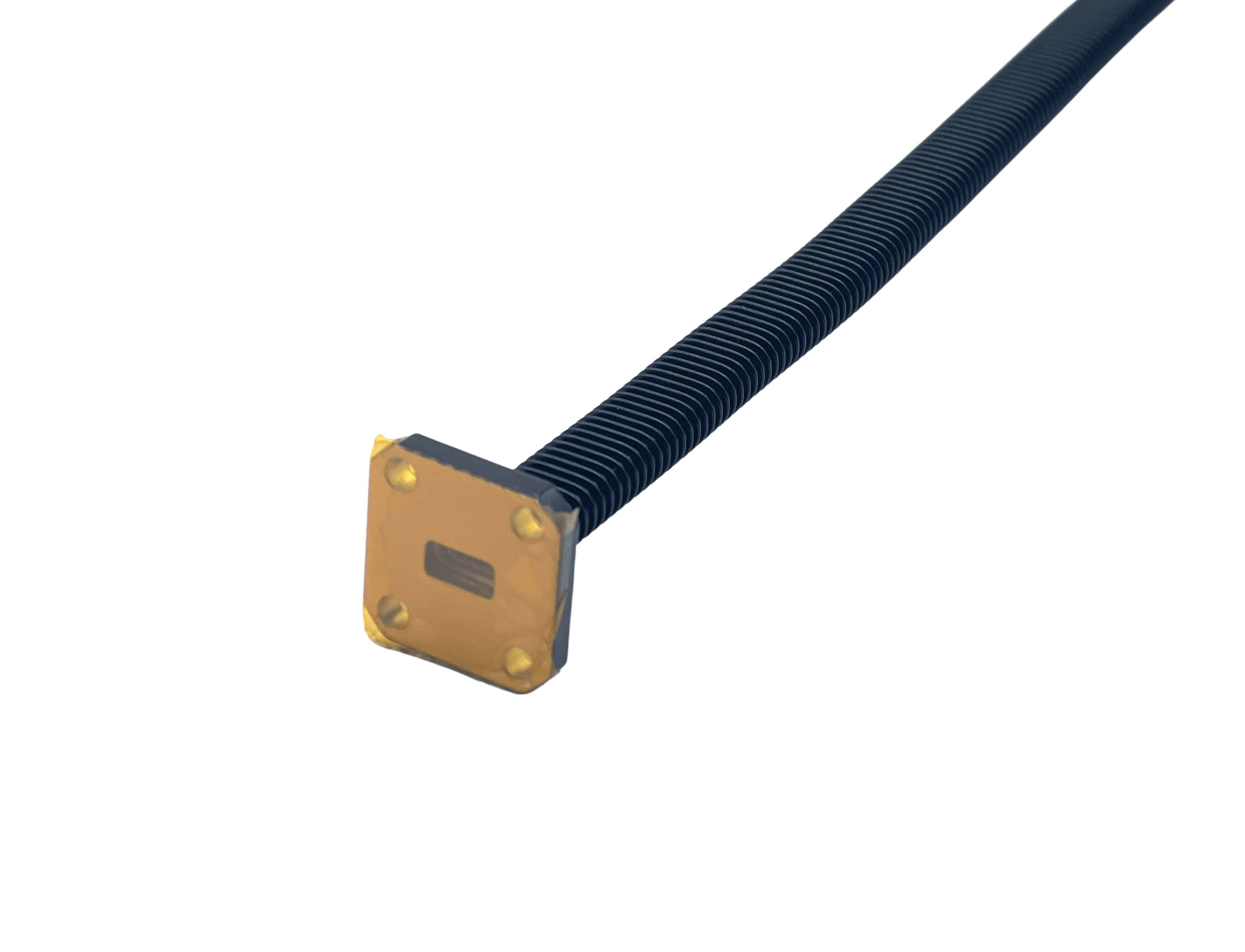
Flexible & Twistable Waveguides for Compact RF Routing
Flexible and twistable waveguides solve routing challenges in space-constrained RF and mmWave systems. These components enable complex interconnections while maintaining excellent electrical performance from L-band through millimeter-wave frequencies. Corrugated construction allows tight bend radii without compromising signal integrity, making them ideal for SATCOM, defense, 5G/6G infrastructure, and laboratory test setups.
Technical Specifications
- Frequency Range: WR284 down to WR28 (1.12 GHz to 110 GHz)
- Construction: Seamless, corrugated inner conductor with protective outer sleeve
- Electrical Performance: Low VSWR across operating band, minimal insertion loss
- Bend Radius: Significantly reduced compared to rigid waveguides
- Available Types: Standard flexible waveguides, seamless waveguides (WR770-WR28), flexible double-ridged waveguides
- Connector Options: UG-flange interfaces, SMA compatibility for select bands
- Environmental Rating: Suitable for outdoor, airborne, and harsh operational conditions
Application Areas
- SATCOM & Satellite Payloads: Ground stations and satellite communication systems requiring compact interconnections
- Defense & Radar: Military radar and electronic warfare systems with stringent spatial constraints
- 5G/6G Infrastructure: Base station installations and distributed antenna systems (DAS)
- Test & Measurement: LNA/HPA characterization and mmWave device validation in laboratory environments
- Airborne & Shipboard Systems: RF systems where weight and space optimization are critical
The mechanical flexibility eliminates the need for costly right-angle bends and transitions, reducing system complexity and component count. These waveguides maintain superior shielding and low-loss characteristics inherent to waveguide transmission while offering enhanced mechanical properties.
bq-microwave stocks flexible and twistable waveguides from leading manufacturers including AT Microwave, ensuring rapid availability for prototype development and production deployments.